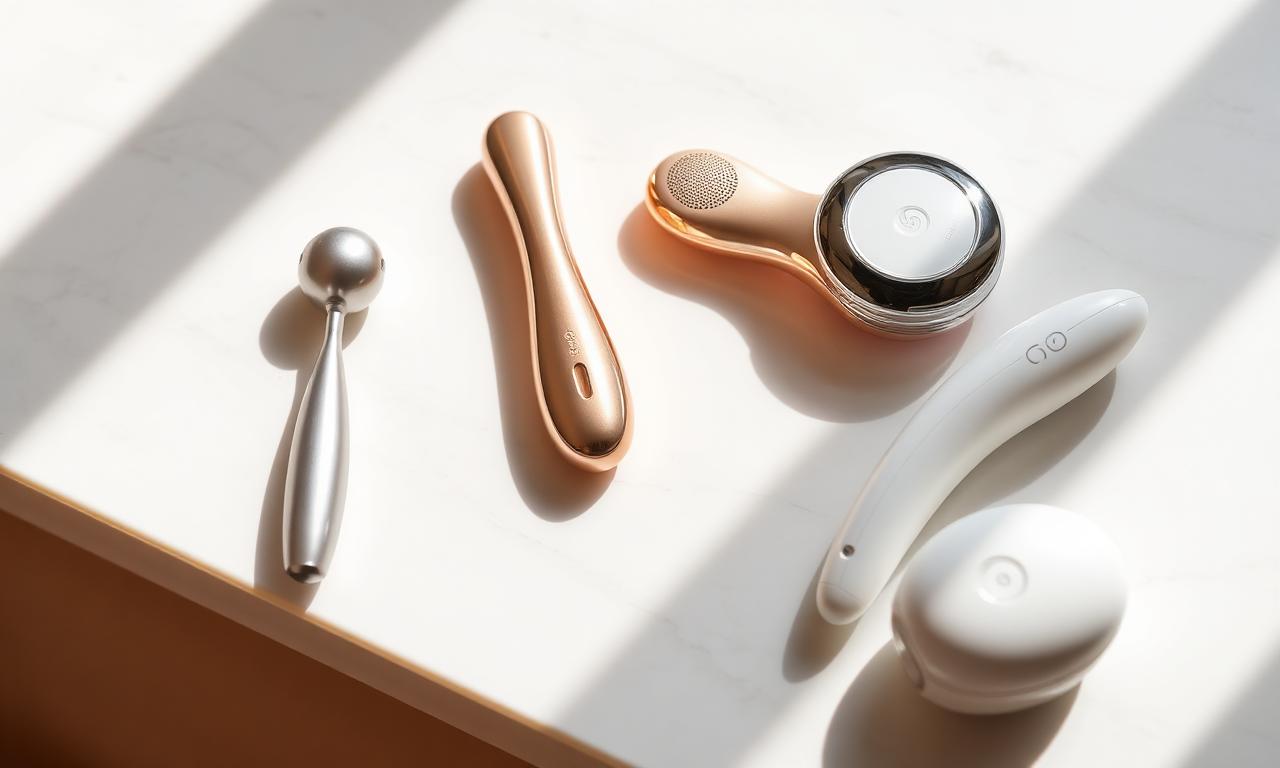
The best microcurrent device for sagging jowls in 2026 is the NuFACE Trinity+ — it's the most clinically proven at-home device for visible jawline lifting after 60 days of 5-times-per-week use. The ZIIP Halo is the most advanced premium pick, and the Foreo Bear is the best beginner option because it doesn't require conductive gel.
If you've watched your jawline slowly soften and your jowls start to settle, you're not imagining it — and you're not alone. The mid-to-late 30s is when most people first notice that the clean angle between cheek and chin begins to blur. By the 40s and 50s, gravity, collagen decline and weakened facial muscles combine to produce the heavy lower-face look that no contour stick can fix.
That's exactly why microcurrent devices have become the most-searched category in at-home beauty tech. They're one of the few non-invasive treatments with real evidence behind them for lifting the muscles that hold up the lower face — and the at-home versions have finally caught up to the salon machines aestheticians have used for 40 years.
This guide is the unflinching version: which microcurrent device is actually best for sagging jowls in 2026, who each device is right for, what realistic timelines look like, and where the "instant lift" marketing is honest versus where it's nonsense. For the wider landscape of skincare tech, see our pillar guide on the best at-home beauty devices, which covers microcurrent, RF, LED and ultrasonic side by side.
What Is a Microcurrent Device?
A microcurrent device uses very low-level electrical currents — typically between 200 and 400 microamps — to gently stimulate the muscles underneath your skin. The current is sub-sensory, meaning you shouldn't really feel it (a faint metallic taste at most), but it's strong enough to trigger the same muscle response that voluntary contraction does.
The face has more than 40 individual muscles. Some of them — particularly the platysma, depressor anguli oris and zygomaticus — directly support the lower face, jawline and jowl area. When those muscles weaken with age, the soft tissue they support drops. Microcurrent essentially re-educates and re-tones those muscles, lifting the tissue they hold from underneath.
There are three things microcurrent does, and one thing it doesn't:
- Tones underlying facial muscles — the primary effect.
- Boosts ATP (cellular energy) production — research from the 1980s onward shows up to 500% ATP increase, which supports skin repair.
- Improves circulation and lymphatic drainage — which reduces puffiness and visible inflammation.
- Doesn't tighten loose skin directly. That's what RF does. For combined skin + muscle results, pair microcurrent with our recommended RF skin tightening device.
Do Microcurrent Devices Actually Work?
Short answer: yes, but only with consistency. The most-cited clinical study (Allergan-funded but independently designed) on NuFACE showed measurable improvements in facial muscle tone and jawline contour after 60 days of 5-times-per-week, 5-minutes-per-zone use. That's the protocol the entire category is built around — and skipping it is the #1 reason people say "microcurrent didn't work for me."
Realistic expectations break down like this:
- Single session: A subtle "snatched" look that lasts 12–24 hours. Great before an event.
- Week 2–4: Slightly firmer feel in the cheeks; you notice it in the mirror before others do.
- Week 6–8: Visible jawline improvement, less jowl heaviness — this is when results "click."
- Week 12+: Cumulative lift becomes the new baseline; maintenance drops to 2–3 sessions per week.
If you can't realistically commit to 4–5 sessions per week for 60 days, microcurrent is not the right device for you — and any honest reviewer should tell you that upfront.
Best Overall Microcurrent Devices
The five devices below cover every budget and experience level. Each has been chosen for proven results on the jowl/jawline area specifically — not just general "facial toning."
| Product | Rating | Price | Key Features | Action |
|---|---|---|---|---|
| NuFACE Trinity+ | 4.8/5 ⭐ | $395 |
| View Deal |
| ZIIP Halo | 4.7/5 ⭐ | $499 |
| View Deal |
| Foreo Bear | 4.6/5 ⭐ | $299 |
| View Deal |
| MyoLift Mini | 4.7/5 ⭐ | $209 |
| View Deal |
| PureLift Face | 4.5/5 ⭐ | $295 |
| View Deal |
1. NuFACE Trinity+ — Best Overall for Jowls
The Trinity+ is the device most dermatologists and aestheticians recommend when a patient asks "what should I use at home?" It's the most clinically studied at-home microcurrent device, runs at the full 400 microamps that match professional standards, and has the smart app integration that earlier NuFACE models lacked.
Where it really earns its place at #1 is on the jowl area: the sphere electrodes are sized perfectly for the under-jaw and along-the-jawline glide patterns that lift this zone. Most users see meaningful jowl improvement by week 8 of consistent use.
Pros
- Clinically proven for jawline lifting — the most studied at-home device
- Full 400 μA — matches professional-grade output
- Smart app with guided programs (optional)
- Cordless, travel-friendly, premium build
- Works with budget gel alternatives (see our gel guide)
Cons
- Requires conductive gel — ongoing cost
- 5 sessions/week commitment is non-negotiable
- Premium price tag at $395
Best for: Anyone with visible jowls or softening jawline who can commit to 5 sessions per week for 60+ days. The most reliable choice if you only buy one device.
2. ZIIP Halo — Best for Advanced Users
ZIIP is the most technologically ambitious at-home microcurrent device. Where NuFACE focuses purely on microcurrent lifting, ZIIP combines nanocurrent (much higher frequency, targets skin clarity, pigmentation and fine lines) with microcurrent (muscle lifting). It's app-driven — every treatment is a downloaded program with specific waveforms tuned to a goal.
The trade-off: ZIIP is not a grab-and-go device. You have to open the app, choose a program, and follow it. For advanced users who want maximum customization, this is exactly the appeal. For first-time microcurrent users, it can feel like overkill.
Pros
- Dual nano + microcurrent — broader skin benefits than NuFACE
- Program library updated regularly via app
- Excellent for fine lines + lifting combined
- Premium ergonomic design
Cons
- Most expensive in the lineup ($499)
- App dependency — phone required every session
- Steeper learning curve
- Gel required
Best for: Skincare enthusiasts who want one device for both wrinkles and lifting, and don't mind app-guided routines.
3. Foreo Bear — Best for Beginners
The Bear's killer feature is its Anti-Shock System — a skin-conductivity sensor that auto-adjusts the current 100 times per second based on your skin's resistance. The result: no conductive gel required, no buzzing or zapping, and a 2-minute-per-zone session that's almost impossible to mess up.
The Bear also combines microcurrent with T-Sonic vibration, which delivers an immediate "depuffed" look on top of the gradual lifting effect. It's not the strongest device in the lineup, but it's the easiest to actually stick with — and consistency is what produces results.
Pros
- No conductive gel needed — works with any serum
- Anti-Shock System eliminates zapping/discomfort
- Fast 2-minute-per-zone routines
- T-Sonic vibration adds instant depuffing
- Most beginner-friendly device in the lineup
Cons
- Lower max intensity than NuFACE/ZIIP
- Best for prevention + early laxity, not severe jowls
- App is helpful but not required
Best for: First-time microcurrent users, anyone in their late 20s–early 40s focused on prevention, and people who won't commit to a gel-based routine.
4. MyoLift Mini — Best Professional-Level
MyoLift is the brand many estheticians use in their own facials, and the Mini brings that professional-grade hardware home at a surprisingly fair price. It's a dual-probe device (two separate handpieces you hold like a salon professional), giving you precise control over the exact muscle path you're treating.
The Mini has no app, no preset programs, and no built-in coaching — which is actually the appeal for advanced users who want to design their own routines and dial intensity by hand. It's also wired, which keeps the output consistent.
Pros
- Genuine professional-grade microcurrent
- Dual-probe precision for individual muscle work
- Variable intensity dial — full control
- Excellent value for pro-level hardware ($209)
Cons
- No app, no guided routines — learning curve
- Wired only — less travel-friendly
- Requires gel + buying separate accessories
Best for: Confident microcurrent users who want professional results without the smart-device hand-holding.
5. PureLift Face — Best for Fast Daily Lift
PureLift uses a patented waveform that delivers a noticeable lifting sensation in just 2 minutes — by far the fastest "I look better right now" effect of any device on this list. It's wireless, intuitive, and designed for people whose biggest barrier to microcurrent is time.
Pros
- Visible lift in a 2-minute session
- Wireless and very easy to use
- Strong waveform pattern for jowl area
Cons
- Less long-term study data than NuFACE
- Gel required
- Lower customization than ZIIP/MyoLift
At-a-Glance Specs Comparison
| Device | Treatment | App | Session | Intensity | Power | Best Concern | Price |
|---|---|---|---|---|---|---|---|
| NuFACE Trinity+ | Microcurrent | Yes | 5 min/zone | 3 levels | Cordless | Jowls, jawline | $395 |
| ZIIP Halo | Nano + microcurrent | Yes | 3–10 min | Programmed | Cordless | Jowls, fine lines | $499 |
| Foreo Bear | Microcurrent + T-Sonic | Yes | 2 min/zone | 5 levels | Cordless | Beginner lifting | $299 |
| MyoLift Mini | Microcurrent (dual probe) | No | 10 min/zone | Variable dial | Wired | Pro-level sculpting | $209 |
| PureLift Face | Microcurrent (waveform) | No | 2 min | 3 levels | Cordless | Quick daily lift | $295 |
Best Microcurrent Device for Beginners
The Foreo Bear wins this category for one decisive reason: it doesn't require conductive gel. The single biggest reason beginners abandon microcurrent isn't a lack of results — it's running out of gel, forgetting to reorder it, and quietly letting the routine die. The Bear bypasses that failure mode entirely.
Pair the Foreo Bear with a daily 2-minute morning routine and you'll build a sustainable habit faster than with any premium gel-based device. Upgrade to NuFACE or ZIIP later once you've proven to yourself you'll actually use it.
Best Professional-Level Microcurrent Device
For advanced users who want salon-grade hardware, the MyoLift Mini is the clear winner. Its dual-probe design mirrors what aestheticians use professionally, and the variable intensity dial allows you to target individual muscles the way a trained therapist would.
If money is no object and you want the most premium experience, the ZIIP Halo is the runner-up — particularly for users who want microcurrent plus nanocurrent in one device.
Best Budget Microcurrent Devices
Under $250, your two best options are the MyoLift Mini ($209) for pro-grade hardware and the older NuFACE Mini ($199 when on sale) for the proven NuFACE waveform in a stripped-down package. Avoid microcurrent devices selling for under $80 — they typically deliver currents far below the therapeutic 200–400 μA threshold and produce no measurable results.
Your ongoing budget item is conductive gel. Brand-name NuFACE gel is expensive; see our guide on NuFACE conductive gel alternatives for safe, dermatologist-approved options at a fraction of the price.
NuFACE vs ZIIP — Side-by-Side Comparison
This is the most-searched comparison in the microcurrent category, and the honest answer is: they're optimized for different goals.
| Feature | NuFACE Trinity+ | ZIIP Halo |
|---|---|---|
| Core Tech | Traditional microcurrent (up to 400 μA) | Nano current + microcurrent combined |
| Conductive Gel | Required (Aqua Gel or alt.) | Required (Golden Gel or alt.) |
| App Required | Optional — works standalone | Required — programs run from app |
| Session Length | 5 min per zone (20 min full face) | 3–12 min programs |
| Best For | Sagging jowls, jawline definition | Fine lines + jowls, advanced users |
| Learning Curve | Easy — clear glide patterns | Medium — app-guided |
| Price | $395 | $499 |
| Best Pick If | You want the proven jowl-lifter | You want the most premium tech |
Bottom line: If sagging jowls are your primary concern, choose NuFACE Trinity+. If you want one device to handle jowls plus fine lines, dullness and pigmentation, choose ZIIP Halo.
Foreo Bear vs NuFACE — Side-by-Side Comparison
This is the comparison most beginners ask about: the gel-free Foreo Bear vs the proven NuFACE Trinity+.
| Feature | Foreo Bear | NuFACE Trinity+ |
|---|---|---|
| Tech | Microcurrent + T-Sonic vibration | Pure microcurrent |
| Gel Needed | No gel required (serum is fine) | Conductive gel required |
| Session Length | ~2 min per zone | ~5 min per zone |
| Skin Sensor | Anti-Shock System adapts current | Manual intensity control |
| Learning Curve | Beginner-friendly | Easy with clear gel patterns |
| Best For | Beginners, prevention, fast routines | Visible jowl correction |
| Price | $299 | $395 |
Bottom line: Pick the Foreo Bear if you're under 40, focused on prevention, and want to skip the gel routine. Pick NuFACE Trinity+ if you already see clear jowl sagging and want the strongest available lift with clinical backing.
How Long Does It Take to See Results?
Microcurrent is one of the most "honest" categories in beauty tech — the timeline is well-documented and consistent across users.
- Session 1: Mild visible lift, lasts 12–24 hours.
- Week 2: Skin feels slightly firmer; you may need to look for it.
- Week 4: Friends start to comment that you look "rested."
- Week 6–8: The "click" moment — jowls noticeably less heavy, jawline visibly cleaner.
- Week 12: Cumulative lift becomes your new baseline. Drop to 2–3 maintenance sessions per week.
- Stop using: Results fade gradually over 4–6 weeks.
Can Microcurrent Tighten Jowls?
Yes — but in a specific way. Microcurrent doesn't tighten the skin; it tones the muscle underneath. For jowls, this is actually the right mechanism, because most jowl heaviness in your 30s–50s is driven by weakening of the platysma and depressor muscles, not pure skin laxity.
As those muscles re-tone with consistent microcurrent use, the soft tissue they support lifts visibly. For more severe jowls in the 60s+, where genuine skin laxity is the dominant issue, microcurrent works best when combined with an RF skin tightening device: RF tightens the skin from above, microcurrent lifts the muscle from below.
Do You Need Conductive Gel?
For every microcurrent device on this list except the Foreo Bear, the answer is yes — conductive gel is required to safely and effectively transmit the current. Skipping the gel doesn't just reduce effectiveness; it can cause minor zapping and skin irritation.
The brand-name NuFACE Aqua Gel is excellent but expensive ($30/tube). Many cheaper alternatives work identically — pure aloe vera gel, hyaluronic acid serums, and several drugstore options. Our complete NuFACE gel alternatives guide covers what to use and what to avoid.
Common Mistakes People Make with Microcurrent
Avoid these — they're why most people quit
- 1. Inconsistent use. Twice a week won't deliver clinical results. The protocol is 5 sessions/week for 60 days.
- 2. Skimping on gel. Dry-glide causes zapping and no current transmission. Apply gel generously.
- 3. Wrong direction. Always glide upward and outward against gravity. Downward strokes work against the lift.
- 4. Too-fast glides. Each glide should take 5+ seconds. Speed-running negates the muscle response.
- 5. Quitting at week 4. Visible jowl results typically come at week 6–8 — quitting early is the most common reason "it didn't work."
- 6. Using over fillers or with a pacemaker. Both are contraindications — consult your doctor.
Are Expensive Microcurrent Devices Worth It?
Honest answer: only if you'll use them. A $499 ZIIP Halo gathering dust is worse value than a $209 MyoLift Mini you actually use 5 times a week. Premium devices justify their price through three real advantages — stronger output (closer to the 400 μA professional ceiling), smarter sensors, and better build quality — but none of that matters without consistency.
Our advice: if you're a proven microcurrent user, upgrade to NuFACE Trinity+ or ZIIP Halo for the strongest results. If you're new to the category, start with the Foreo Bear ($299) — prove to yourself that you'll use it daily, and upgrade later if you want stronger lifting.
Final Verdict — Our 2026 Picks
- Best Overall: NuFACE Trinity+ — proven jowl lift, the right pick for most buyers.
- Best Premium: ZIIP Halo — most advanced tech, fine lines + lifting in one.
- Best for Beginners: Foreo Bear — no gel, easiest to stick with.
- Best Professional-Level: MyoLift Mini — salon-grade hardware at home.
- Best for Fast Lift: PureLift Face — visible result in 2 minutes.